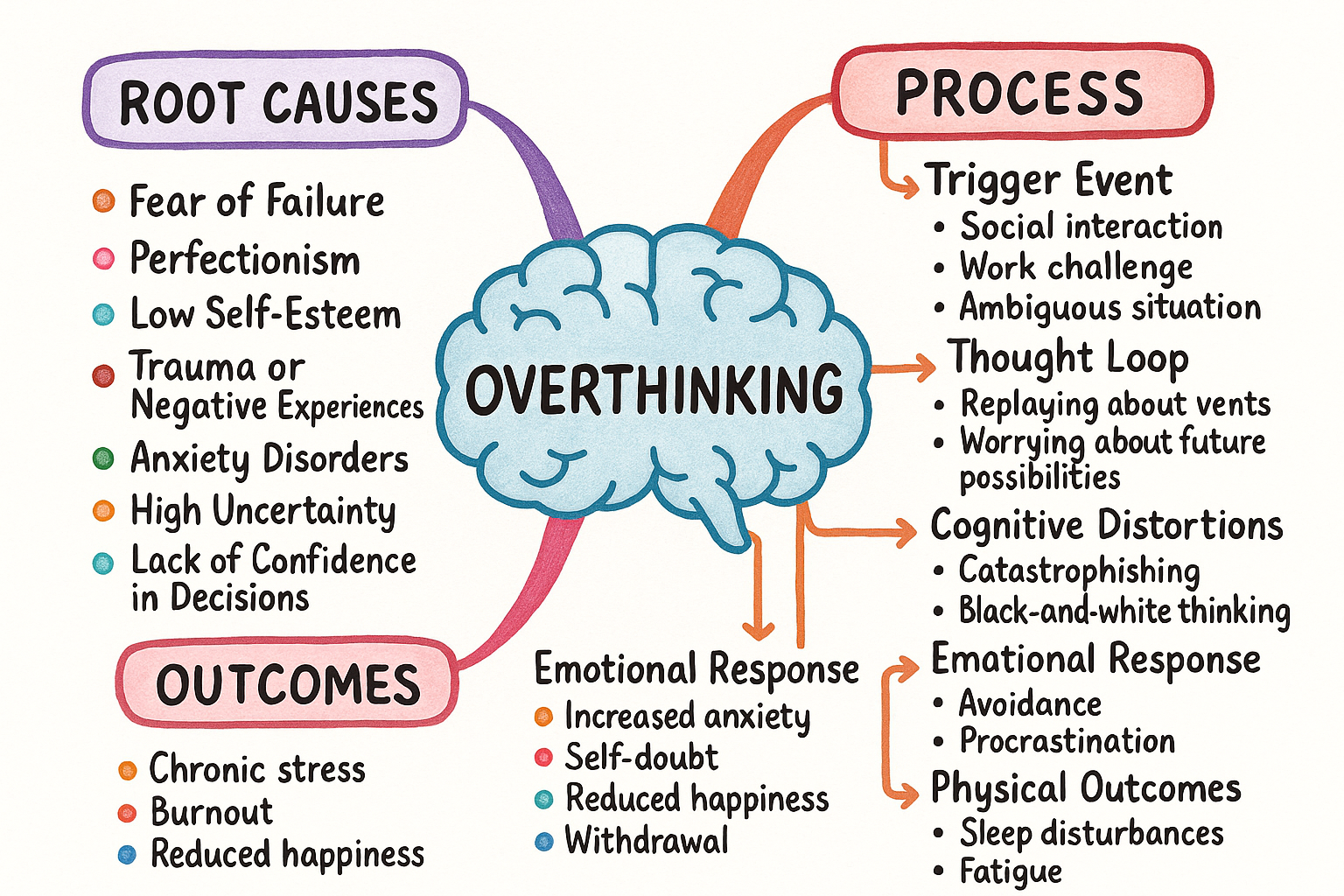
Overthinking: A Survival Mechanism in a Modern World
We often criticise ourselves for overthinking. It keeps us awake at night, paralyses decision-making, and fuels anxiety. But what if we told you that overthinking isn’t a flaw—it’s a survival mechanism, deeply rooted in our evolution?
The Brain’s Design: Built for Survival, Not Peace
Human brains are wired for survival, not happiness. From an evolutionary standpoint, our ancestors faced daily threats—wild animals, unpredictable climates, rival tribes. To stay alive, they needed to anticipate danger before it struck.
This meant constant mental scanning of the environment, interpreting signs, predicting outcomes, and evaluating risks. In that world, overthinking wasn’t just useful—it was essential.
Today, our threats are no longer life-or-death in the same way, but the brain hasn’t updated its software. It still treats uncertainty, social risk, or career challenges as threats. Hence, the mental loops begin.
Why Overthinking Feels So Exhausting
Overthinking typically activates the brain’s default mode network, which kicks in when we’re not actively focused on a task. It’s associated with introspection, rumination, and future planning—all important, but exhausting when left unchecked.

While it once helped us problem-solve and avoid danger, now it often results in:
- Decision paralysis
- Increased stress and anxiety
- Disrupted sleep
- Reduced confidence
We ruminate over a comment from a colleague as though it were a warning of tribal exile. We replay a meeting endlessly as if our survival depends on how we came across. In some ways, the brain thinks it does.
Reframing Overthinking with Compassion
Understanding overthinking as a survival tool allows us to approach it with more compassion. It’s not a personal weakness; it’s your brain doing what it was designed to do. The trick is helping it adapt to today’s world.
Try:
- Grounding in the present: mindfulness or breathwork helps calm the nervous system.
- Journaling: gives structure to scattered thoughts and reduces internal clutter.
- Challenging cognitive distortions: like catastrophising or black-and-white thinking.
- Naming the fear: what is your mind trying to protect you from?
From Survival to Thriving
It’s empowering to recognise that overthinking is your brain’s way of trying to keep you safe. But we can teach it that safety doesn’t always come from control or certainty.
In today’s world, resilience is often about knowing when to let go, not hold on tighter.
So next time you find yourself stuck in a thought spiral, pause and thank your brain—it’s only trying to help. Then, gently remind it that you’re no longer in the jungle.
You’re just human, navigating modern life—with an ancient mind doing its best to keep up.