
Why Self-Criticism, Perfectionism, and Inadequacy are Trauma Responses
Self-criticism, perfectionism and feelings of inadequacy are manifestations of trauma responses, often imprinted on us in our childhood. Trauma can be defined as an overwhelmingly distressing event or series of events that overwhelm a person’s ability to cope, resulting in lasting negative impacts on their physical, emotional, and mental well-being.
Survival Adaptation in Unsafe Environments
As children (or even as adults), if we experienced environments where love, safety or approval were either conditional or absent, we frequently adapted by trying to be “perfect”. In this manner we strived to avoid criticism or disapproval, and to invite approval and love. The attachment models which we learned in early childhood are often replicated in our adult relationships, whether work, social or personal.
Self criticism becomes a way to pre-empt external criticism, e.g. “If I notice and put it right/fix my flaws first, then maybe I won’t be hurt or rejected by the people that matter”. In early childhood this would almost certainly be our primary and secondary carers – for example, our parents, grandparents, or carers. Interestingly, many adults are scarcely aware of their own self-deprecating internal narrative, borrowed from the expressed views of those early imprints. Or if they are aware, they may not have fully realised that these originated in their formative years.
Our feelings of inadequacy may stem from internalised messages, such as “you’re stupid”, “you’ll never be successful”, or “you’re not good enough”; repeatedly having needs dismissed, not being seen or heard wires the nervous system to expect rejection. Verbal, mental and emotional abuse across the settings we experience in early life all have an impact on the way in which we approach life situations. We can find it difficult or impossible to express what we truly feel, find a voice to ask for what we need, or to set appropriate and healthy boundaries. Abuse can perhaps be defined as any interaction with another individual which impacts upon us negatively and causes harm, whether spiritually, mentally, emotionally, or physically.

Hypervigilance and Control
Trauma puts our nervous system on high alert, and can keep it at that level persistently. In this situation, perfectionism is an attempt (often unconscious) to control outcomes, and to avoid danger, rejection or abandonment. Often our minds create a narrative which is not representative of the reality of situations we find ourselves in. We can see or hear nuances which are the product of our fear and our internal dialogue, rather than of our external environment.
Self-criticism acts like an internal alarm system or radar. This means that we constantly scan our own behaviour and the external environment for any sign that we may have made a mistake, in order to stay safe and to avoid what the subconscious perceives as danger. This can manifest as self-blame, guilt, second-guessing, anxiety, repeatedly revisiting what we have said or written, or unnecessary apologies for imagined wrongdoing. We may even apologise when the other person has behaved badly or inappropriately, shouldering the blame for any failing in the interaction. We may find it hard to set boundaries, and to assert ourselves, even when the situation calls for us to do so, because our default position is that we are at fault.
We often feel that we must have complete control over our environment, which includes having all the answers to any questions we may have. The unknown feels unsafe and must be made safe – now. This might manifest as impatience, irritability, feelings of insecurity, expectations of instant responses from others to our questions or demands, restlessness and inability to focus or concentrate.
Attachment Wounds
The importance of the quality of care, love and attention we received during our early years, and into our teens, cannot be understated. In situations where caregivers or important figures have provided inconsistent love or approval, or love and approval have been absent altogether, we develop unhealthy attachment models with those adults. To see the importance of this, we only have to examine the relationship between adult and child and note the probable outcome.
The illustration below gives an summary of the various attachment models. It needs to be clarified that each of us usually displays a combination of different styles, depending on the relationships we had with different adults as a child, and how that plays into the connections we have as adults. We may respond differently to different individuals and situations, depending on which aspect of our psyche is triggered by the interaction and connection with them. We are likely to have a “default” style, but will be capable of responding differently depending upon the situation.
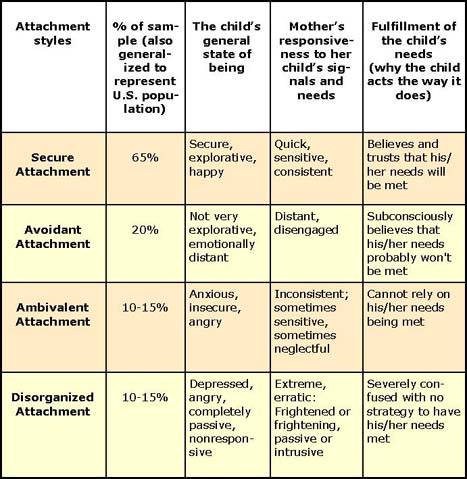
Poor or inadequate attachment in our early years, creates an ingrained belief that equates worthiness with achievement. That breeds self-criticism, perfectionism and inadequacy. We may feel that the only way to attain the love and approval we need is by achieving, or over-achieving. This sets the tone for our adult life, but may leave us with having reached many worthwhile and laudable goals, but still with a feeling of something being missing.
While achieving feels satisfying on some levels, it may leave us with a sense that the goal reached is somehow hollow, or missing something. We often find that instead of being able to enjoy and appreciate our achievement, that sense of lack merely pushes us on and forward towards the next objective. In purely professional terms, this is a driver for success, both in terms of financial security and social status. We may find ourselves in a schism between our outer and inner lives.
It’s important to stress that these traits are not character flaws, but protective strategies we developed as young children, that were designed to create or preserve connection.
How to Combat Them (Healing Approaches)
Healing doesn’t mean erasing these tendencies overnight, but retraining the nervous system and internal voice, using a broad spectrum of techniques (“tools”). This is work which can be self-led or therapist-led, but it is we, the individual, who must do the work.
Some of the techniques laid out here may be ones that your therapist give you to practice between sessions. How much impact they have, how much positive change they bring about is up to whether we commit to and practice this “homework”.
Awareness and Self-Compassion
Start listening for your own internal voice or voices. We all have these. One of the most common is the critical voice; another is the authoritarian voice; hopefully we have a nurturing, compassionate and loving voice as well.
As you begin to become more aware of those internal voices, you can start to separate out what they are telling you. The critical voice is often the one that has adopted all the negative beliefs that were imprinted on you as a child. That teacher who told you that you wouldn’t amount to anything; the parent or other family member who consistently told you that you were stupid. Sometimes circumstances led to you feeling that you failed in some way and you developed the belief that you lacked ability in that particular thing. Over time, these became your ingrained beliefs about yourself. Self-criticism, perfectionism, and inadequacy become a part of every aspect of your life.
The authoritarian voice is the voice which tells you to start, to continue, or to finish tasks that you have in front of you. It’s the taskmaster, the internal manager who keeps you in line and on track.
The nurturing, loving voice is the one that tells you that you’re doing the best you can, that you can acknowledge the good and own it, that it’s okay to be human, fall down, make mistakes. It’s the voice that says “well done” and reminds you that you are loved, valued and appreciated. It’s the voice of kindness and compassion towards self.
Practising awareness and self-compassion allows us to separate out these voices, identify where the unhelpful beliefs about ourselves originated and work to dissolve these. Using the voice of self-love and compassion can soften the over-strict taskmaster, and heal the wounds caused by the inner critic.
Challenge Internalised Beliefs
Write down the self-critical thought (“I’m not good enough at this”).
Ask: Whose voice is this? Is it truly mine, or something I learned to survive?
Reframe the belief; replace it with something balanced, not overly positive—e.g., “I’m learning and that’s okay”, or “I’m doing the best I can and I will get better as I practice”. Use these reframed statements as affirmations while talking kindly to yourself.
Somatic and Nervous System Work
Trauma lives in the body. Practices like breathwork, yoga, EMDR, or somatic experiencing help regulate the fight-flight-freeze response that drives perfectionism and inadequacy. Simple fresh air and exercise, and walking in nature will help to regulate and ground you. It’s important to incorporate the practices which you choose into your life, and not simply do them once or twice and then put them down. Self-regulation isn’t something you do once and don’t need to repeat. After all, would you decide not to eat simply because you had eaten once or twice? No, self-regulation becomes part of our self-care in the same way we try to eat, stay hydrated and get enough sleep. At the same time, this shouldn’t become a rod with which to beat yourself. When we drop off or away from the self-care we need, it’s enough to acknowledge that we stepped off the path, and simply step back on – picking up what we have dropped and starting again. We are still way ahead of where we would be if we hadn’t started caring for ourselves.
Set “Good Enough” Goals
Perfectionists struggle with completion because “perfect” feels like the only safe option. Deliberately practice finishing projects at 80% and observing that the world doesn’t collapse. When you decide to do something, build an understanding of what that would look like if it were “perfect”, and then identify the level to which it would be “okay”; work to that instead. Remind yourself that you have already achieved something worthwhile by starting and that your 80% is almost certainly someone else’s 100%.
Inner Child Work
Many of these patterns of self-criticism, perfectionism and inadequacy arise from childhood wounds. Connecting with that younger part of yourself—through journaling, therapy, or visualisation—can help meet the needs that weren’t met back then.
Therapeutic Support
Trauma-informed therapies (IFS, EMDR, BWRT, CBT, somatic therapy) are powerful in breaking the cycle of inadequacy and self-criticism
Key idea: Self-criticism, perfectionism, and inadequacy are not flaws—they are old survival strategies. Healing is about teaching the nervous system and inner world that safety and worth are not conditional anymore.